.svg)

Every ambitious city now has a start-up hub. While some focus on climate tech, AI, or agricultural innovation, Munich, Germany, has set its sights on building Europe’s largest circular start-up ecosystem. Just a few years after its establishment, it already holds the title of Germany’s largest circular hub—an achievement driven in part by the Circularity Gap Report Munich.
CIRCULAR REPUBLIC was founded in 2023 with an audacious goal: to build Europe’s largest innovation hub for the circular economy. While Munich already boasted one of Europe’s strongest innovation and startup ecosystems, the circular economy lacked public recognition and an evidence base at the city level.
‘To set a milestone early on, we asked ourselves: what can we do that really puts Munich on the circular economy map?’, says Matthias Ballweg, co-founder of CIRCULAR REPUBLIC, ‘And that’s how we came up with the idea: why don't we do a city-level Circularity Gap Report? We were all circular economy enthusiasts and practitioners, so we obviously knew about the Circularity Gap Report’.
True to their innovative spirit, the founders of CIRCULAR REPUBLIC were undeterred by the fact that the Circularity Gap Report(CGR) had never been conducted for a city. On the contrary, blazing the trail for other cities only strengthened the statement they sought to make. In addition, CIRCULAR REPUBLIC approached the City of Munich with an offer to collaborate on the report. The city agreed, and the CGR Munich was born.
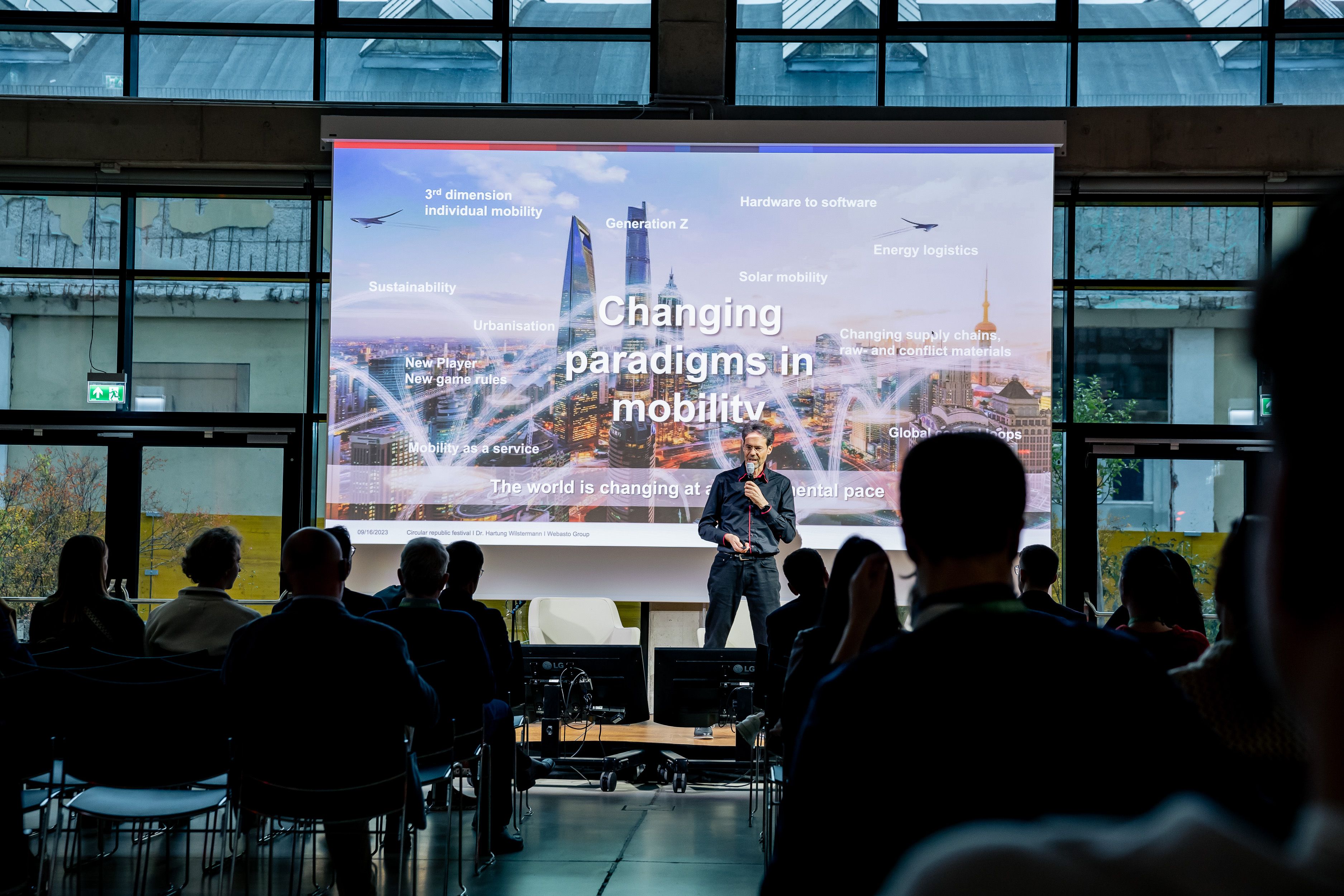
The launch of the CGR Munich in November 2023 gave CIRCULAR REPUBLIC the publicity it needed. The report was the key topic of the first Circular Republic Festival, which has since become a bi-annual event. According to Matthias Ballweg, headline indicators presented in the report made it easier to convince policymakers, entrepreneurs, and the wider public of the importance of circularity. ‘The CGR Munich revealed that our material footprint of 32 tonnes per inhabitant was significantly higher than the German and European averages’, he recalls. ‘This number opens eyes. And once eyes are open, doors open. Then you can start talking about action’.
The report not only lent credibility to CIRCULAR REPUBLIC as a new organisation, but also identified priority sectors for the circular transition and established a baseline for measuring progress. Combined with the involvement of the city government and local businesses, this set Munich’s circular start-up hub up for success.
Furthermore, the Munich city government immediately embarked on developing the city’s first circular economy strategy following the report’s launch. Circle Economy was invited to contribute its research to the new policy document, which was published in December 2025. The strategy sets ambitious goals based on key indicators from the CGR Munich, such as a 30% reduction in material use by 2035, with a further target of 50% by 2045, as well as doubling the use of secondary materials (Circularity Metric) by 2035.
Munich’s circular economy startup ecosystem has grown rapidly since the CGR launch. According to Matthias Ballweg, the number of circular economy startups in the city has roughly doubled over the past three years. It now includes 100 start-ups, working on everything from Product-as-a-Service to secondary materials.
One of CIRCULAR REPUBLIC’s recent successes is a multi-stakeholder alliance that managed to recover 80% of the lithium from electric car batteries. As the EV industry grows, so does demand for lithium, a critical raw material. By demonstrating that most of this lithium can be extracted from old batteries and reused, CIRCULAR REPUBLIC and its partners helped address one of the industry’s biggest challenges.
Another start-up highlight from Munich is Delicious Data, which develops an AI algorithm for bakeries and other food companies, enabling them to forecast demand, produce more efficiently and thus reduce waste and cut costs. And the customers get fresher buns and pretzels—a win-win.
These examples demonstrate that circularity is not only beneficial for the environment. For the City of Munich, it has expanded an already thriving innovation ecosystem and attracted top talent. For the companies that benefited from the solutions they developed, it reduced costs and addressed supply bottlenecks. And for everyone living in Munich, it delivered broader economic and social benefits, from climate resilience to new jobs and green spaces.

-p-500.jpeg)


